
You have the title, the experience, and a track record of delivering results. Colleagues rely on you. From the outside, your career looks like a success story. Yet by the end of the day, you may have little energy left for the people and activities that matter to you.
That disconnect deserves attention. A successful career and a sustainable working life are not always the same thing. Understanding the difference can help you recognize when professional demands are taking more than they give back.
AEO Quick Answer: Why Do Successful Professionals Experience Burnout?
Successful professionals can experience burnout when ongoing workplace demands exceed the resources, support, or recovery available to manage them—even when they continue performing well. Career achievements do not eliminate chronic job stress, and visible productivity can make exhaustion, detachment, or declining confidence in one’s work harder to recognize.
Quick Takeaways
- Professional success does not guarantee that work demands are sustainable.
- Burnout is specifically associated with chronic workplace stress, not simply having a busy week.
- Exhaustion, growing cynicism toward work, and reduced professional effectiveness are important warning signs.
- Meaningful improvement may require workplace changes as well as personal habits and boundaries.
- Coaching can support reflection and goal-setting, while persistent mental health symptoms deserve qualified clinical care.
What Burnout Actually Means
The World Health Organization describes burnout as an occupational phenomenon associated with chronic workplace stress that has not been successfully managed. It identifies three dimensions: exhaustion, increased mental distance or negativity toward work, and reduced professional efficacy.
That definition matters. Burnout is not a medical diagnosis, and the term should not be used to explain every kind of tiredness, emotional struggle, or dissatisfaction with life. Some symptoms may overlap with health conditions that require professional assessment.
Still, the workplace signs are worth taking seriously—even if your job performance hasn’t visibly declined.
Why Achievement Doesn’t Always Protect You
The demands can grow while your resources stay the same
Success often brings new projects, larger teams, tighter deadlines, or more people depending on your judgment. None of those responsibilities is necessarily unhealthy. Problems can develop when expectations expand without enough time, staffing, autonomy, or support to meet them.
The American Psychological Association identifies excessive workloads, limited control, inadequate support, and unfair or toxic working conditions among the contributors to burnout. These are workplace conditions—not evidence that someone lacks determination.
Good results can conceal a difficult process
A professional may continue delivering presentations, meeting targets, or supporting coworkers while privately struggling to recover after work. From the outside, consistent output looks reassuring. But performance alone cannot tell you what it costs someone to maintain it.
If your answer to every increase in pressure is to work longer or take on more, it may be time to examine whether the current approach is sustainable—not simply how to become more efficient.
Responsibility and control may be out of balance
Being accountable for outcomes without enough influence over deadlines, priorities, or resources can create ongoing strain. This can affect managers, business owners, and employees alike.
It also explains why personal motivation is not always the solution. The CDC’s workplace mental health guidance, updated in 2026, emphasizes that improving workplace policies and practices is central to addressing work-related stress and burnout.
Signs That Success May Be Masking Strain
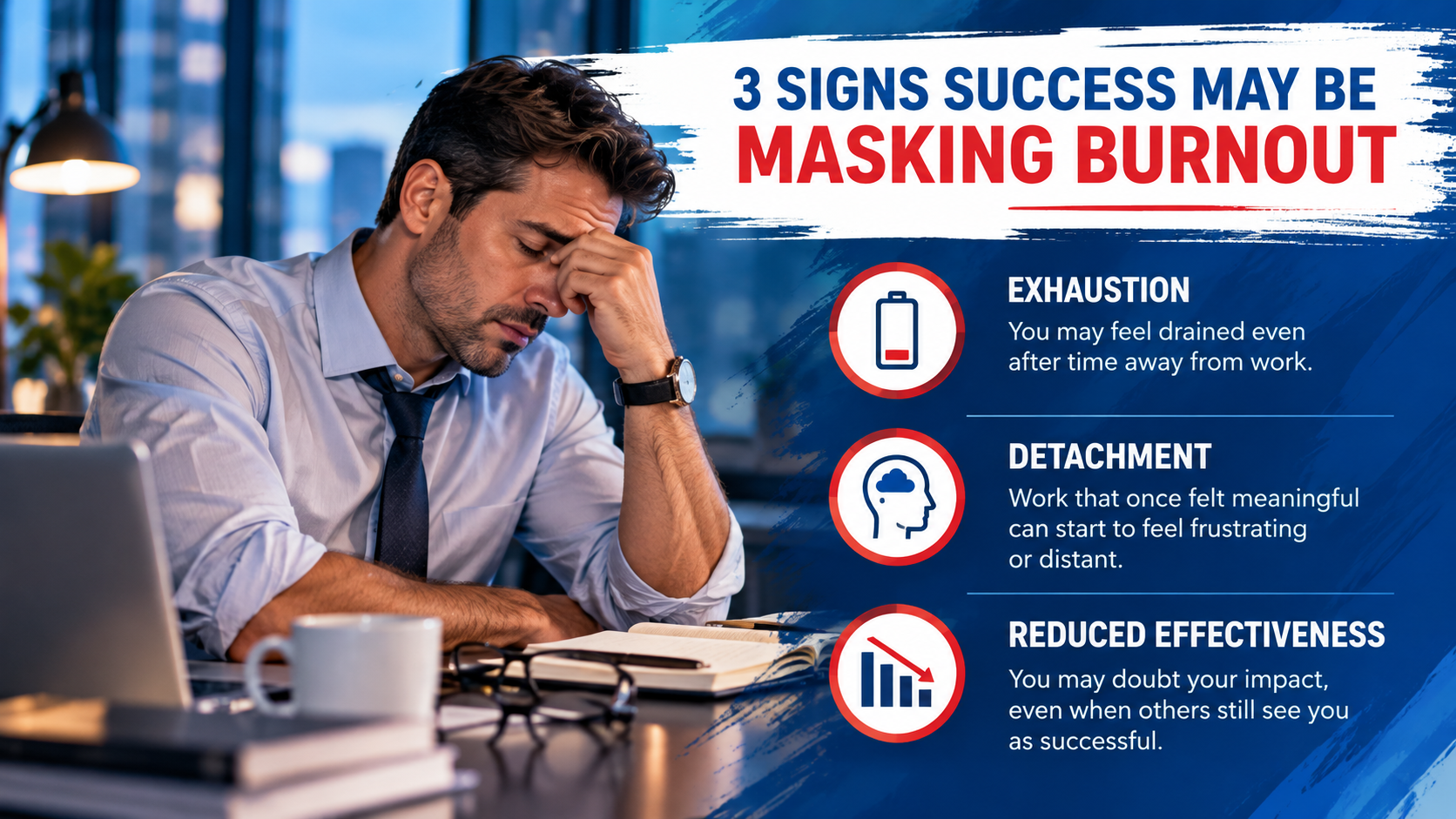
Burnout doesn’t have to look like an obvious collapse. Consider whether any of these patterns have become persistent:
Recovery feels incomplete. You take time away from work but return still feeling depleted, particularly when the same pressures resume.
Work feels increasingly distant. Responsibilities that once felt meaningful now bring cynicism, frustration, or the urge to disengage.
Your sense of effectiveness changes. You may doubt the value of your contribution or feel less capable at work, even when others still see you as successful.
These are prompts for reflection, not a self-diagnosis. Notice how long the changes last, whether they relate to work, and how much they affect your daily life.
Five Practical Ways to Respond

1. Identify what is actually draining your capacity
For a workweek, jot down the responsibilities that require the most energy, the resources available, and the situations where you feel you have little control. Look for patterns rather than blaming yourself for an especially difficult day.
The aim is to identify a changeable condition: an unrealistic deadline, unclear priorities, excessive meetings, or work that regularly extends beyond agreed hours.
2. Raise the workload issue with something specific
If you work within an organization, discuss concrete demands and possible adjustments with an appropriate manager or team member. Rather than saying only that you’re overwhelmed, identify the trade-off: “If this project becomes the priority, which deadline can move?”
Business owners can apply the same question to what they accept, delegate, postpone, or stop doing. Some conditions require organizational decisions, not just better personal time management.
3. Protect one workable boundary
Choose a boundary you can realistically maintain, such as a defined end to your workday on certain evenings or protected time without routine work messages. Explain it where necessary and review whether it holds.
A boundary is not a cure for excessive workplace demands. It can, however, make those demands more visible and preserve time for life outside work.
4. Make recovery a regular part of your schedule
Rest, movement, relationships, and enjoyable activities are worth protecting without requiring you to “earn” them through extra productivity. Start with a manageable adjustment rather than attempting a complete lifestyle overhaul.
If your work environment continuously prevents adequate recovery, return to the conditions creating that pressure. More self-care cannot, on its own, resolve an unmanageable workload.
5. Seek the right kind of support
A trusted colleague, supervisor, friend, or coach may help you think through priorities and next steps. If symptoms are persistent, worsening, or interfering with daily functioning, consult a qualified healthcare or mental health professional. The National Institute of Mental Health offers guidance on when to seek professional help.
Where High-Performance Coaching Can Fit
Recognizing work-related strain sometimes raises a larger question: What do you want your professional success to make possible in the rest of your life?
Glen Smith Jr. offers high-performance and personal transformation coaching for people who appear successful externally but want greater alignment between their goals, daily choices, and personal well-being. His Rewire, Optimize, Activate framework addresses limiting beliefs, physical well-being and energy, and purposeful action with accountability.
Coaching can provide space to clarify priorities, examine habits, and establish practical goals. It does not diagnose burnout, treat anxiety or depression, or replace psychotherapy, medical care, or necessary changes to workplace conditions.
Frequently Asked Questions
Can you experience burnout and still do your job well?
Yes. Strong performance does not necessarily reveal how a person feels or how much effort sustaining that performance requires. Pay attention to ongoing work-related exhaustion, detachment, and changes in perceived effectiveness—not just outward results.
Is burnout the same as depression or anxiety?
No. Burnout refers specifically to the workplace context, while depression and anxiety are mental health conditions that can affect many parts of life. Symptoms can overlap, so a qualified healthcare professional is the appropriate person to assess persistent or concerning symptoms.
Do I have to leave my job to address burnout?
Not necessarily. Depending on the situation, changes to workload, control, support, expectations, or working arrangements may help. If meaningful improvements are not possible, reassessing the role or environment may be worth considering.
Your Next Step: Define What Sustainable Success Looks Like
You don’t have to wait until your work or well-being deteriorates to consider what needs to change. If you’re performing well but questioning whether your current pace fits the life you want, a conversation about your goals and priorities may be a useful place to start. Book a free discovery session with Glen Smith Jr. today!